Table Partition
Description / Background
Partitioning is a database design principle that helps improve performance and manageability of large tables by dividing them into smaller, more manageable pieces. Each partition can be managed and queried separately, which can lead to performance improvements for large datasets.
Create a table partition for inventory, package agenda start times, inventory reservation and inventory tablecheck.
Glossary
https://app.clickup.com/9003122396/docs/8ca1fpw-35796/8ca1fpw-41516
Objectives
- Optimize the performance of the inventory worker, reducing processing time.
- The inventory system working normal
- Speed up data lookup
- Reduce server load
- The
generate_partitions(inventory, package agenda start times, inventory reservation and inventory tablecheck) method in the migration defines partitions based on ranges ofrestaurant_id.
example:
partition p1 includes all rows where restaurant_id is less than 100, p2 includes rows where restaurant_id is less than 200, and so on.
Scope
data flow
Location
-
Sequence Diagram / Flow
-
ERD
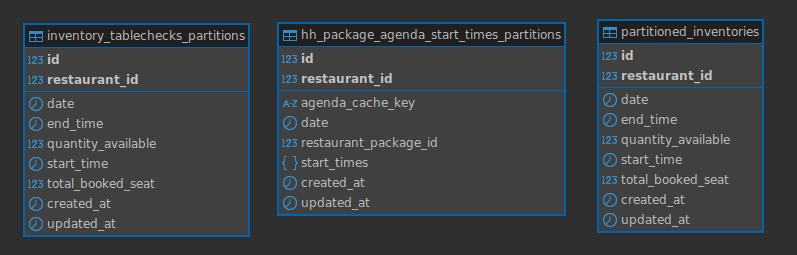
In the database, this partition table doesn’t relate to any other table, they just use the Active Record Association, so the model can be connected. This model uses composite primary keys, which means that the primary key is a combination of two columns: :id and :restaurant_id.
Backend Implementation
-
* Add gem `composite_primary_keys`- Delete old inventory and package agenda start time partition table
- Add new inventory and package agenda start time partition table
- Migrate the old data partition to the new partition table
- Change the inventory model to use the
inventory_partitionstable. Use the ID and restaurant ID as the composite ID for the inventory partition table. - Change the HhPackage::AgendaStartTime model to use the
hh_package_agenda_start_times_partitionstable. Use the ID and restaurant ID as the composite ID for thehh_package_agenda_start_times_partitionstable. - Add restaurant_id, when the worker send agenda_start_times params
- Add restaurant_id when you find inventory by id.
example:
Inventory.find([params[:id], params[:restaurant_id]])
https://github.com/hungryhub-team/hh-server/pull/5658/files
Frontend Implementation
-
PRD & Task
https://app.clickup.com/t/86cvv9hzt no PRD
Design
-
API Blueprint
| Method | Path | URL | Description | Payload |
|---|---|---|---|---|
New Query
-
DB Schema / Database Migration
Add new table inventories_partitions
Add new table hh_package_agenda_start_times_partitions
Add new table inventory_tablechecks_partitions
Add new table inventory_reservations_partitions
Improvement:
| NO | Date Time | What Changed | Description |
|---|---|---|---|